Artist spotlight: Kinetic Graphics
- mailika
- Sep 12, 2024
- 4 min read
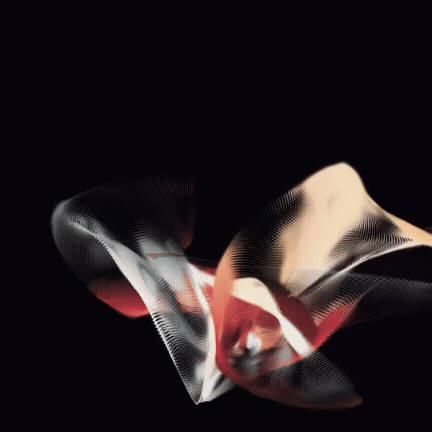
Jeremy Seeman, Also known as "Kinetic Graphics" is a Canadian 3D artist focused on abstract movement and animation. He enjoys creating artwork with the intent on surprising viewers by forcing a perspective in an interesting way, oftentimes leaving the viewers with a sense of satisfaction, awe, or even deliberate discomfort. He finds inspiration in mathematics, rhythm, simple geometry and the patterns found in nature.
Read his interview below:

Horizontal 17
Can you describe your journey from graphic design to 3D art? What motivated the shift?
I started exploring 3D as an extension of my graphic design skills, aiming to break into packaging design. Initially, I wanted to generate ideas and share them on social media, but they didn't gain much traction. So, I pivoted to creating animations, inspired by those "oddly satisfying" perfect loops we’ve all seen. Over time, my own style and techniques began to emerge, and that’s how I arrived where I am today.
Your work often features realistic objects in surreal, unrealistic movements. How do you achieve this balance between realism and surrealism in your animations?
3D space is perfect for "breaking reality." For instance, I might bend a pencil like a noodle. Honestly, I don’t prioritize balance—some ideas look great in my head but fail in execution. However, the process of trying is always valuable, even if the final piece never sees the light of day.

Vertical 20
How does your fascination with M.C. Escher and mathematical phenomena like the Fibonacci sequence influence your creative process?
Studying Escher in high school was a turning point for me, showing how math and patterns could create fascinating art. This stayed with me, and when I began learning 3D animation, it was natural to incorporate elements like the Fibonacci sequence and the golden ratio, which are ubiquitous in nature.
Nature seems to play a significant role in your art. How do you incorporate natural harmony and balance into your surreal compositions?
I usually start with an animated movement and then consider how it could exist in a “realistic” environment, either complementing or contrasting the motion. It's rare that I begin with a nature scene and fit the movement into it—often, the environment isn’t necessary for the piece to be compelling. Sometimes, simplicity is key.
In what ways has your background in graphic design informed your approach to 3D art? Are there specific skills or techniques you've brought with you?
Color theory and composition have been incredibly helpful, as has my aptitude for learning new software. But the most significant carryovers are the soft skills, like understanding target audiences and designing for them. My goal was to grow Kinetic Graphics, so I knew I had only a few seconds to capture attention on social media. This has shaped much of my work, though not all of it.
Horizontal 11
Can you share more about how transitioning to full-time 3D art and NFTs has impacted your artistic practice and daily routine?
I’ve been fortunate that my social media growth has brought in clients and opportunities to sell artwork as NFTs. Since leaving full-time employment in May 2022, I’ve found success, which has given me the freedom to focus on art during slower periods. It has its challenges, but it’s working well for me.
What challenges did you face when moving from traditional graphic design to 3D art, and what advice would you give your past self to reach where you are quicker?
I would advise myself to recognize when I’m hired as an artist rather than a designer and to embrace my artistic taste. In graphic design, I approached every project with a brief and a target audience in mind, which sometimes left me unsure of what to do. Now, I understand the difference and can confidently run with it.
How do you stay inspired and continue to innovate in your work? Are there particular sources of inspiration or practices you rely on?
Limitations often inspire creativity. For example, when I use an equation to drive movement, I’m confined within certain parameters, which forces me to think outside the box to create something compelling. I also have a growing pile of unfinished animations that I revisit with fresh perspectives.
Could you walk us through the creative process for some of your recent works on Blackdove? From concept to completion, how do you develop and refine your ideas?
My first series on Blackdove started as a semi-generative collection. I used dice rolls to determine various factors, such as the number of textures and colors. I created 100 possibilities, then refined them by hand until they met my standards, eventually selecting only 20 for Blackdove. My latest pieces, created over the past year, were chosen for their ability to work well as vertical or horizontal displays, which is crucial for Blackdove.
Looking ahead, do you have any new directions or projects in mind that you’re excited about? What can we expect to see from you in the future?
I’m working on a project involving infinity mirrors visualized in 3D space, which requires a lot of effort, but I’m excited about where it could lead.


Comments