Lake Heckaman: On generated fluidity and organic patterns
- mailika
- Sep 15, 2024
- 3 min read
Lake Heckaman is a Brooklyn-based new media artist who explores the subjectivity of lived experience through interactive installations and generative compositions. His work immerses viewers in multi-sensory environments inspired by the abstract beauty of nature.
Lake's art has been exhibited internationally, including at Art Basel Miami and galleries in New York, Paris, and Singapore. He has also created permanent installations, such as a weather-reactive facade at Hotel Diez in Medellin, Colombia, and an interactive experience at the National Western Heritage Museum in Oklahoma City.
Read his interview below:
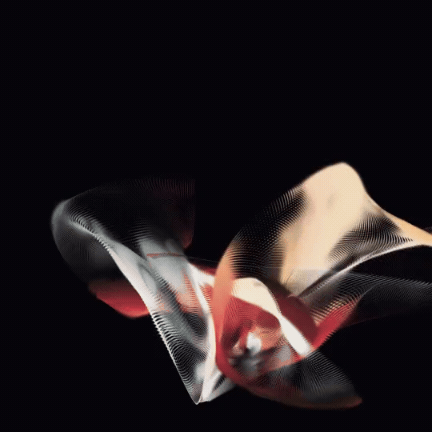
Ornithologies 02
How do you define subjectivity in the context of your interactive installations, and how does it shape your creative process?
Subjectivity is our unique point of view, sculpted by our interactions with the environment, others, and our minds. My work makes this explicit, allowing viewers to touch and change the composition, embodying their perspective through interaction. This mirrors how we engage with our world, and my process integrates these ideas into cohesive, generative designs.
Can you share an example of how nature has influenced one of your recent works?
I often start with mathematical models of natural phenomena. For instance, in Surface Tensions, I used fluid simulations and ray-tracing to mimic light refracting through water, creating organic patterns that evoke the natural world. This approach helps build viewers' intuition and connection to the piece.
How do different cultural contexts influence the reception of your work?
Interactive new media thrives on cultural diversity, with each viewer bringing their own context to the piece. My use of universal elements like water or birds allows people from various backgrounds to connect with the work. Immersing myself in different cultures also adds depth to my practice, as I learn to see my work through new lenses.

Maelstrom 00
What were the challenges and rewards of creating the weather-reactive facade at Hotel Diez in Medellin?
Site-specific work offers unique challenges, like budget constraints and logistical issues, which can fuel creativity. For Hotel Diez, limited LED pixels led us to use diffusion panels, transforming the installation into a soft, radiant facade that reflects Medellin's weather. These constraints ultimately enhanced the project's tone and impact.
How does the generative aspect of your art affect the viewer’s experience, and what role does unpredictability play?
Generative art mirrors the unpredictability of human experience. Each interaction with my work changes it, just as our actions shape our consciousness. This dynamic, evolving nature of my art keeps it constantly fresh and reflective of the viewer's engagement, creating a unique experience every time.
How do you integrate generative art and physical installations in your practice, and why are both important to you?
My practice combines generative compositions with site-specific installations. This allows me to explore both digital and physical realms, integrating the beauty of nature with human interaction. These installations challenge and deepen my understanding of human experience, making each project a learning opportunity.

Subduction 01
How has being based in Brooklyn influenced your artistic vision and opportunities?
Brooklyn's vibrant art scene and close-knit creative community constantly inspire and motivate me. Being surrounded by other artists and resources enhances my work, providing both practical support and creative collaboration.
What role does technology play in your work, and how do you see it evolving in the future of new media art?
Technology is central to my work, from the code that powers my art to the sensors and screens that make it interactive. As technology evolves, so will the possibilities for new media art, expanding how we create and experience art.
How do you consider sensory aspects like sound, light, and movement when designing an installation?
The senses are the foundation of interaction design. I consider how viewers will engage with the work through touch, sight, and sound, creating feedback loops that connect them to the art. This multi-sensory approach deepens their experience, making the art more immersive and impactful.
What new projects or concepts are you excited about exploring?
I'm launching an interactive installation in Las Vegas next month and releasing a new series of generative artworks this fall. I'm also working on museum and architectural projects for 2025, which I look forward to sharing soon.


Comments